Tony Schiavo
Chief Technology Officer
For more than a decade, the narrative of U.S. credit markets was defined by “electronification,” the move from phones to screens that transformed bond trading. Today, we are entering an even more dynamic phase, one that is defined by intelligent automation.
At Trumid, we’ve always believed that better technology, higher-quality data, and intentional product design could fundamentally reshape how corporate bonds trade. And AI, as you might imagine, dramatically expands that belief.
As early adopters of new and emerging technology, we’re about five years into our own AI/ML journey, which feels as pivotal as when air travel entered the jet age. Initially, AI was an interesting prototype in the hangar. Then it became a compelling promise. Now, many of the biggest and most transformational changes have begun to show up in how we build, ship, and operate the platform, signaling the arrival of true jet propulsion in our operating model.
As I reflect on our progress – and AI’s leaps – I’m convinced it represents a fundamental shift in how we work across every department, freeing our people from toil so they can spend more time on creativity and the next set of ideas.
We have begun to solve the ‘time problem’ for our teams, but the ultimate goal is to turn that efficiency outward and, over time, help remove the repetition and manual friction from our clients’ daily workflows so they can focus more on strategy, risk, and relationships.
Indeed, at Trumid, AI is no longer an experiment; it is increasingly becoming part of our operating model.
This is the first in a series of posts where we’ll pull back the curtain on how we’re approaching this shift — not as a chase for attention, but as a way of contributing to the broader AI conversation: what we’re trying, what’s actually helping, and where we’re still figuring things out.
Many of the biggest and most transformational changes have begun to show up in how we build, ship, and operate the platform.
What excites me about AI is that it lets us flip that dynamic — we can get bigger and faster at the same time.
Starting from Values, Not Tools
Before we talk about AI models or agents, it’s important to talk about trust. Ultimately, our credibility drives our business and earns us the opportunity to serve our clients. Our reputation isn’t just about what we say; it’s built on how we show up—both for our teams and our clients. Additionally, as we build and deploy these tools, we do so with the governance, transparency, and controls needed to support our responsibilities—and those of our clients. We protect that standing by staying obsessed with two things: Building Trust and Staying Nimble.
Maintaining our agility is a defining principle for us, especially as we’ve observed that growth can often lead to institutional inertia. As companies scale, they can become slower, encumbered by rigid processes, diverting energy toward administrative complexity rather than meaningful innovation.
What excites me about AI is that it lets us flip that dynamic, so true to our ethos, we can get bigger and faster at the same time by automating that repetitive toil – e.g., scaffolding, testing, boilerplate – that would drag others down.

We’re about five years into our own AI journey, which feels as pivotal as when air travel entered the jet age.
Tony Schiavo, Chief Technology Officer
I believe AI is the most powerful tool we’ve ever had for the time problem, helping to move ideas from the whiteboard to production far faster. It’s why we’re able to accelerate our release cycle and set new platform records simultaneously, ensuring our infrastructure evolves as quickly as the market demands.
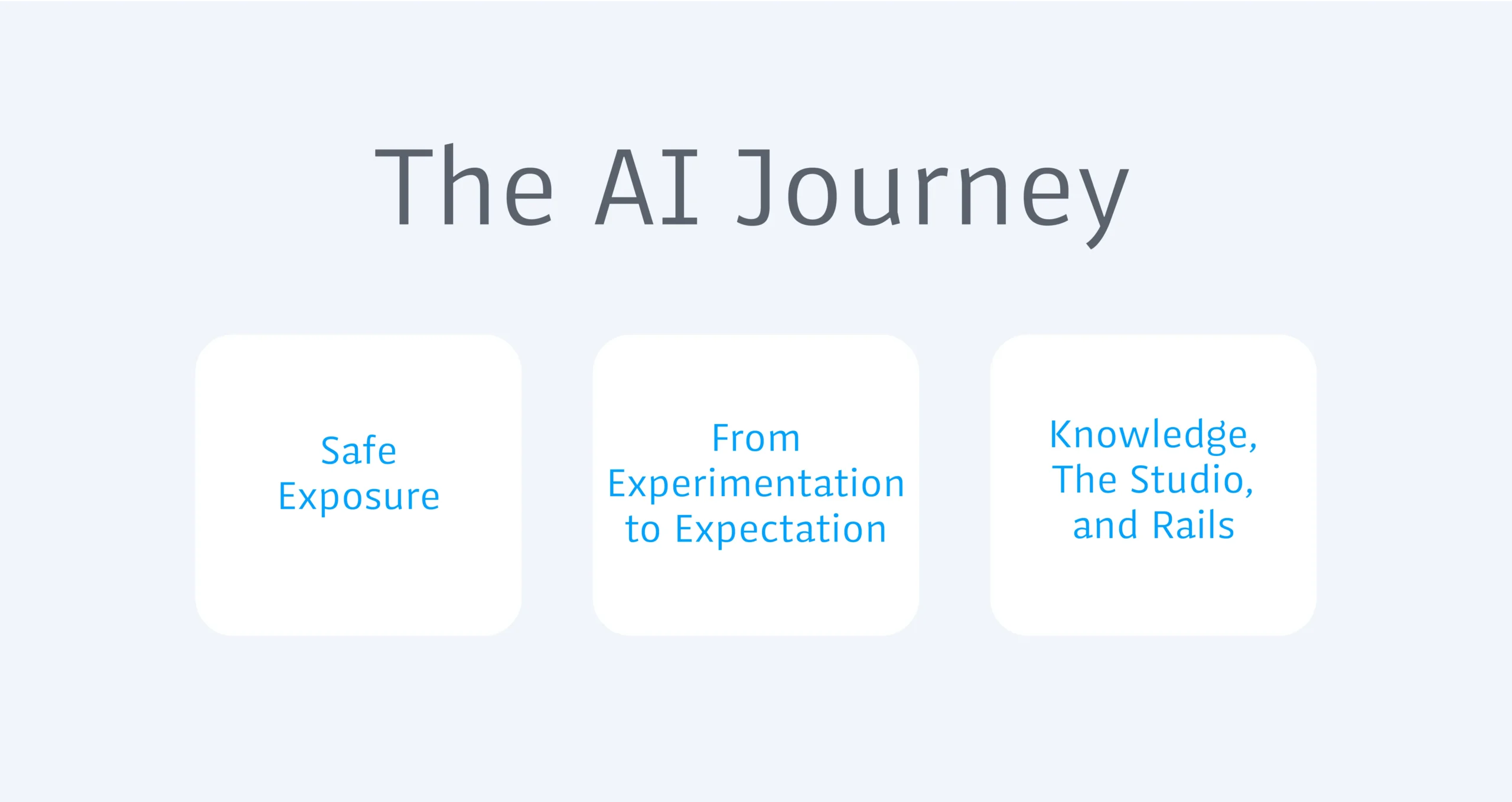
The AI Journey: From Playground to Rails
Of course, we didn’t get here by flipping a switch or strapping a jet engine onto the old airframe. Our journey has followed a deliberate, three-phase evolution:
Pre-2024: Safe Exposure
When Large Language Models (LLMs) gained momentum, our first priority as a FINRA member and SEC registered broker dealer operating an ATS was “safe play.” We gave teams a secure, padded room to experiment – an isolated, controlled environment where they could poke at the tech within basic guidelines. The goal was to stoke their curiosity and build an AI “comfort level,” while improving our ability to deliver on another core value for our clients: Agility at Scale.
2025: From Experimentation to Expectation
In 2025, we raised the bar across our tech and product teams, moving from “you can use AI” to “we increasingly expect you to use it where it makes sense” in your workflow. We increased our targets for pull requests per engineer, knowing the most practical way to hit those marks was to lean on AI for the repetitive parts of development – refactoring, scaffolding, unit tests – instead of grinding through everything by hand.
As we accelerated AI adoption internally, we moved from monthly releases to weekly, and then toward a near‑continuous delivery cadence – all while setting new records for platform volume and client engagement and strengthening platform stability and reliability.
Automation and AI‑assisted refactors, test generation, and automated regression testing meant we could keep hardening the platform even as our market share surged. We aimed AI directly at improving the quality of everything we do internally, allowing us to ship smaller, safer changes to clients more frequently than ever before.
2026: Knowledge, The Studio, and Rails
This year, we are getting serious at a systems level, focusing on three pillars:
- The Knowledge Base: We are “bottling” our firm’s institutional expertise to create a consistent foundation for our team and AI. This system “remembers” the nuances of credit workflows and complexities of the market, helping our teams deliver more consistent, intelligent platform support and faster feature development.
- The Studio: Before anything looks like a “factory,” we’ve been investing in the Studio — a place where humans and AI work side-by-side to explore ideas, sketch solutions, and iterate quickly. This is where we let teams play safely, learn the tools, and turn rough concepts into something production-worthy.
- The AI “Factory”: Once we trust a pattern, we move it into a factory of AI workflows. We design and operate these capabilities within secure, controlled environments and governance frameworks to ensure consistency and quality. Just as 3D printing uses a “Benchy” tugboat to test a machine, we’ve developed our own “Benchy” tests for AI outputs to make sure every component meets our quality, reliability, and control standards.
"We’ve been investing in the Studio — a place where humans and AI work side-by-side."
The Path Forward: "World 2.0"
We call this cultural shift “World 2.0.” It’s a future where our subject matter experts stop answering the same questions a thousand times and instead teach the system, so everyone can benefit from that collective knowledge.
And we’re doing all of this within the strict guardrails of a regulated industry. This is disciplined innovation: using AI to find new opportunities while holding client information sacred and not compromising on the reliability, security, and trust that define Trumid — all data operates within a secure, controlled environment under our governance and permissioning framework.
We’re still early in this journey. Nobody has all the answers for the “right” way to apply AI to credit trading, so we’re approaching it with humility and the same relentless pursuit of “getting a little better” that’s gotten us this far.
The way I think about it: the piston-engine era is behind us. We’re refactoring the plane for jet propulsion — stronger systems, better instrumentation, and tighter feedback loops — so our teams and our clients can move faster with more confidence. If we get this right, AI won’t feel like a flashy engine bolted onto an old airframe; it will feel like a different kind of aircraft altogether, one that changes what clients can expect from an electronic credit platform.
Next: The Trumid Tech Blog - AI Journey Series
We invite you to follow this new series of blog posts as we go deeper into our technical approach, our commitment to disciplined innovation, and our vision for the future of intelligent trading. As we chart this AI journey, you can expect us to cover these topics and more:
- Foundations – Why we leaned into AI and how we built a safe playground.
- AI Inside Trumid – How our teams work differently with developer tools and internal copilots.
- AI and the Desk – Deep dives into workflow and trade automation.
- Measuring & Scaling – How we measure client and market impact and where the roadmap leads next.
Coming next: We’ll dive into AI-driven Systems Development Life Cycle (SDLC) and how we’re able to deliver innovation to our clients faster than ever before.
Related Articles